
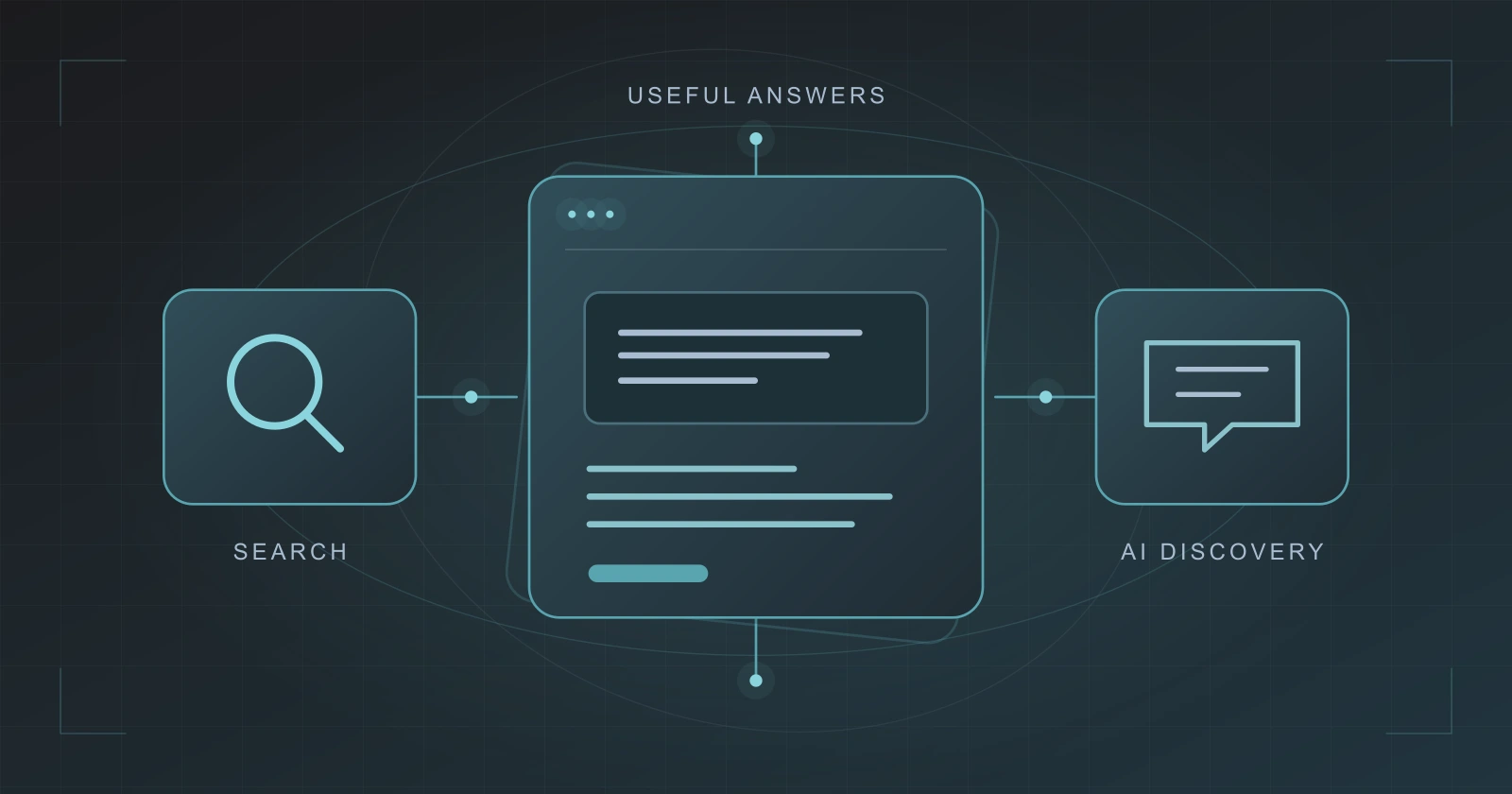
Start with the page a prospective customer reads before deciding whether to contact you. Does it explain what you offer, answer their questions, and make the next step clear? Improving that page gives your search work a useful starting point, whatever acronym is attached to it.
SEO, AEO, and GEO describe overlapping approaches to helping people find information. Understanding the differences can help you plan the work without creating a separate content strategy for every term.
What do SEO, AEO, and GEO mean?
- SEO, or search engine optimization, helps search engines discover and understand your pages so people can find them through relevant searches.
- AEO, or answer engine optimization, is commonly used to describe work that helps content answer specific questions in search and other answer-based experiences.
- GEO, or generative engine optimization, focuses on visibility in responses produced by generative AI systems, including how those systems reference or describe a business.
For a business planning its website, the useful question is what each approach changes in practice. If a proposal recommends new pages, technical fixes, or a reporting tool, ask which customer need it addresses and how the work will be evaluated.
What does Google require for its AI search features?
Google says its existing SEO practices apply to AI Overviews and AI Mode. There is no special AI file or schema markup required. To be eligible as a supporting link, a page must be indexed and eligible to appear in Google Search with a snippet. Meeting those conditions does not guarantee inclusion. Google’s guidance on AI features explains these requirements.
That guidance covers Google’s features. It does not establish a universal formula for every AI platform. Treat any promise of guaranteed AI citations with care.
Use a customer question to improve a service page
Consider a hypothetical website redesign page. A prospective client wants to know: “Can you move the content from my current website?” A headline about building better websites leaves that question unanswered.
A useful explanation could read:
We can migrate existing pages, media, and product catalogs. Your proposal will define the content and data to move, the redirects needed, and the testing included.
That answer describes the work and explains where the scope is agreed. The rest of the page can cover supported platforms, responsibilities, and what the client needs to provide. Those details help someone decide whether the service fits their project.
Review one of your own service pages with these checks:
- Answer early. Put the main explanation near the top, where someone looking for that service will find it.
- Use descriptive headings. “What does migration include?” is more useful than a heading that could belong on any page.
- Explain the boundaries. Say what is included, what depends on the project, and what needs a separate discussion.
- Connect the next step. Link to relevant services or supporting articles, then offer an inquiry route that fits the page.
Add detail where a reader needs it. Google explicitly says it has no preferred word count, so stretching a complete answer to hit a target length serves little purpose. See its guidance on helpful, people-first content.
Decide what you will check after the update
Record the page’s current search performance and the kinds of inquiries it brings in. After the changes, look for relevant searches, visits, and qualified inquiries. Review the questions prospects still ask; repeated confusion may reveal what the page needs next.
Google includes traffic from AI Overviews and AI Mode in Search Console’s overall Web performance reporting. Avoid describing those totals as a separate count of AI visits. Google’s measurement guidance sets out that distinction.
You can also review selected AI responses for how they describe your business, recording the query, platform, and date. Treat those observations as a limited sample. They can reveal an inaccurate description without proving how visible your business is across an entire platform.
RVABro Media’s SEO & AI Search service brings together research, content writing, technical and on-page fixes, and ongoing review. The scope can focus on a one-time project or continued monitoring and improvement.